How to Fund a Hospital in a Warzone
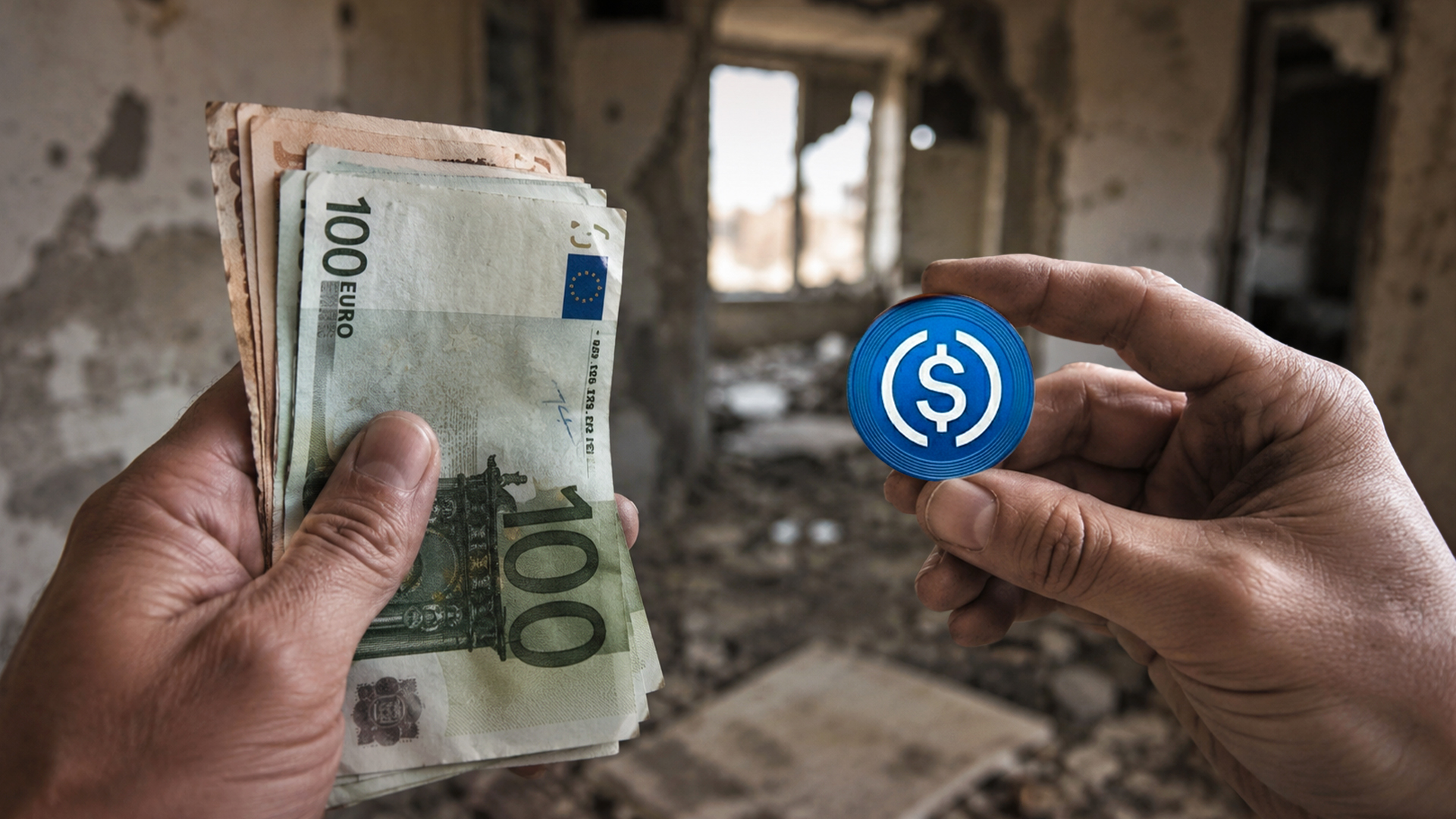


In Northwest Syria, a critical network of hospitals faces a unique challenge: how do you pay medical staff and fund healthcare when your country is completely cut off from the global financial system?
Due to economic sanctions and a fractured banking infrastructure following over a decade of civil war, humanitarian organizations like the Union of Medical Care and Relief Organizations (UOSSM) have struggled to safely distribute funds.
Previously, hospital employees had to embark on grueling, risky journeys to the Turkish border, waiting in long lines for hours just to collect their salaries in physical cash.
In this episode of Money Trails, presented by Stellar Development Foundation., we take a firsthand look at how the evolution of cross-border payments is impacting real lives on the ground.
New episodes straight to your inbox.
Get them as soon as they're published.
Transcript
Justin Norman: There's something I've always wondered: when you donate to an NGO, what happens next? How does the money actually get to the people the NGO is supposed to be helping? Those questions are more complicated when the aid is going to a country in crisis, like Syria, torn apart by more than a decade of civil war.
News Clip: When they bombed this hospital. People here are taking the threat seriously, and they no longer feel safe.
Justin Norman: Two years ago, the employees of this hospital were paid in cash that was driven over this border from Turkey into northwest Syria. Because of economic sanctions, the country was cut off from the global financial ecosystem, meaning that organizations operating in the country couldn't easily pay their employees or fund their operations, and it's the everyday people who suffer.
Maryam al-Jasem: Physical exhaustion, psychological exhaustion, and a financial loss before you've even collected what you're owed.
So I found the people building new systems that address these questions, and the solutions aren't what you'd expect.
In Northwest Syria, there's a network of hospitals providing critical care to a region lacking basic health resources. It's operated by the Union of Medical Care and Relief Organizations, also known as UOSSM, and entirely funded by foreign donors. But until recently, this is what hospital employees would have to go through to collect their salary
Muhammad al-Hassan: We were forced to make long trips just to collect our pay.
Justin Norman: UOSSM employees needed to collect their salary payments at a branch of the Turkish Postal Bank, which was hours away from Idlib.
Sheikh Salem: We'd have to leave at midnight just to arrive early enough to get a queue number. If you arrived late, there was no spot. We'd go all that way, wait in huge crowds, finally reach the cashier, only to be told there was no money left.
Justin Norman: It could take weeks for them to actually receive their salaries.
Maryam al-Jasem: So, essentially, you’re weighing your options: should you just accept the current arrangement—receiving half in Euros and half in Turkish Lira—or not? The alternative would be to go back—to actually travel all the way back, make a new booking, and pay the fees all over again. That means paying for the trip expenses a second time, just so that I can eventually receive the entire payment in Euros.
Justin Norman: Hospital workers driving hours away from home, waiting even longer in line just to collect their salaries. Why did they have to go through this?
Syrians recently endured a 13-year civil war, which started in 2011 as part of the wider Arab Spring protests.
The war was devastating. An estimated 500,000 people were killed and around half the pre-war population of 22 million have been displaced, either internally or as refugees abroad. Infrastructure across large parts of the country was destroyed. Hospitals, power grids, roads, financial institutions.
News Clip: The United States has imposed sanctions on the Syrian president over human rights abuses.
Justin Norman: The US and Europe both issued sanctions against the Syrian government, targeting not just the government but any foreign individual or company doing business with it.
News Clip: …prohibits American citizens from engaging in any transactions with the government of Syria.
Justin Norman: This created significant secondary sanctions risk that made even humanitarian organizations cautious about financial transactions involving Syria.
And against this backdrop, UOSSM was launched in 2012.
Younes Al Haj Saleh: So we are a medical humanitarian organization. We do medical aid, we give free checkups, we do operations, we found hospitals, and as well recently in Syria, we did manage to establish the ambulance network.
Justin Norman: Younes Al Haj Saleh is responsible for UOSSM's financial operations.
Younes Al Haj Saleh: Our financial operations here from our HQ got, got denied all the time because we work in countries where is, there's no government or there is, um, difficulties with the financial infrastructure. We struggle to wire money.
Justin Norman: Cut off from the global financial ecosystem, the workaround was to use a bank in Turkey that had branches in northwest Syria, and it was at those branches that UOSSM employees would wait in line for hours to collect their salary.
Younes Al Haj Saleh: Before it was really a headache. We had to wire money from our bank account here in Paris to our bank account in Turkey. From our bank account in Turkey, we had to wire it to the Postal Bank of Turkey, the PTT, who has a nearest office to the northwest Syria, like 30 kilometers away from the border.
Justin Norman: And other times UOSSM would collect and distribute the money directly.
Younes Al Haj Saleh: We had a driver from USSM joined by an employee and security. They drive all the way to Turkey. They take the money in cash, and they drive back to Syria, where they store the cash in a safe in our office, and people used to come and get their salary in hands, which was really non-professional way, not very comfortable for everyone, and we also run a lot of risk.
My colleagues used to drive with a trunk full of cash from, like, 80,000 euros to 150,000 euros. Having SWIFT denying our wires, having normal classical banking refusing to deal with us, even though we can provide them all the documents and papers, they don't want to get flashed because they risk working with us.
So we went fully blockchain stablecoins, and we adopted this solution.
Justin Norman: Today, UOSSM pays its employees with stablecoins, making payments directly into each employee's digital wallets. But for this to work, it relies on an ancient money practice called Hawala.
News Clip: Hawala is the sending of money through parallel channels. The buyers use a network of money brokers without actually moving the cash. The Hawala network is the most efficient way to send and receive money.
Justin Norman: Hawala is an informal method of transferring money in the Middle East, relying entirely on trust and a network of brokers known as Hawaladars. Instead of moving money directly, a sender gives cash to the broker, who contacts their counterpart in the destination, and that counterpart pays the recipient from their own reserves.
The two Hawaladars settle up later. No money actually crosses a border, and the whole thing runs on trust. This informal system of trust moves billions of dollars around the world and has proved vital to helping solve this more modern payments problem in Syria.
Ibrahim Abdulhuseyin: In late 2021, my family was living in Syria, inside Syria, in the city of Jarabulus, and I used to live in Turkey.
I wanted to send remittance to my father. That time it was very difficult, very expensive. There were no banks, no Western Union, no MoneyGram, no formal way to send funds to Syria.
Justin Norman: That's Ibrahim Abdulhuseyin, the co-founder of Digibank, a digital wallet for users in the Middle East.
Ibrahim Abdulhuseyin: I thought, "What if we can use crypto assets like stablecoins to send funds to Syria?"
That time I tried to send using stablecoins, but then my father told me I cannot buy anything with them. No one will accept them here in, in, in Syria. So the idea of Digibank came from here, that we can create an app, you can easily use to convert stablecoins into fiat currencies and vice versa.
Justin Norman: So to convert stablecoins into local currency in a country fighting a civil war with broken financial infrastructure and global sanctions, Digibank tapped into the Hawala networks.
Ibrahim Abdulhuseyin: Back in 2021, what I discovered is that we already have between 3 to 4,000 Hawala agents operating in Syria, and all of them are operating in the traditional way. So I thought it would be a good idea that we can onboard them to Digibank to accept off-ramping, and the idea was is convince enough of them to receive crypto stablecoins and at the same time for off-ramping to our clients.
Tori Samples: The digital wallets and off-ramps are the most crucial piece of the ecosystem. That's what makes these products real for real people living in the real world.
Justin Norman: That's Tori Samples, the director of product at the Stellar Development Foundation.
Tori Samples: The Stellar Disbursement Platform is a tool that we built for bulk payments.
We knew that organizations around the world needed to send money to thousands of people at once. They wanted to do it on a blockchain in order to access fast, cheap, transparent payments. They didn't have a way to do that previously, and so we built one for them. Once we've established that connection, they have a digital wallet, then the funds are just processed instantly.
The payments go right into their digital wallet, and they're notified that they have funds. They don't have to understand blockchain or crypto. They just get an invitation to claim their funds.
Justin Norman: So today, UOSSM is buying the stablecoin USDC for their payroll and uploading a spreadsheet to SDP every month to bulk disburse salary payments into their employees' Digibank wallets. And when a hospital employee receives their salary payments in their wallet, they can view the exchange rates and locations of the Hawala agents, what Digibank calls liquidity points, to convert their digital dollars into physical cash, which is critical in a cash-heavy economy across Syria, where you're not buying things with credit cards or any other digital means.
Ibrahim Abdulhuseyin: Some of these agents don't know about stablecoins or don't know what to do with them. So if, if the agent received, let's say, one thousand USDC, they have no way to convert it back into cash. We guarantee for the agents that we will buy back the USDCs in using traditional methods, either by diverting more clients who wants to on-ramp to USDC, so they can go and put cash in these liquidity points.
Because right now we have two thousand agents, we have like five hundred of them are comfortable in holding stablecoins. But I think in the, in the future, what we saw is there is an increasing number of them are adopting stablecoins.
Justin Norman: You wouldn't think of NGOs and aid organizations as stablecoin users, but the nature of the markets in which they are operating has actually made them some of the most advanced adopters of this technology.
Ibrahim Abdulhuseyin: Aid organizations usually have pain points regarding the fees of the funds they are delivering. This is one. Two, the traceability of funds, which is very, very critical for donors because in context like Syria, NGOs or aid organizations, they don't have an easy way to track funds because funds are fragmented and liquidity is available through Hawala networks.
Their employees will receive the funds in a matter of minutes, and then they can cash out immediately, take up to one day to cash their, their funds. It used to take three months to receive their salaries. It cost twenty percent. Now it costs up to two percent, including the on-ramp fees and the off-ramp fees.
Justin Norman: Even as sanctions are lifted in Syria, it's important to recognize that this isn't just a Syria story. Moving money all around the world is full of friction, delays, middlemen, fees, a lack of transparency. The hard part, the part not as many people talk about, is the last mile. But the last mile in this case wasn't solved by new technology.
It was solved by plugging new technology into a trust network that's been running for centuries. I recognize this isn't the long-term solution to the challenges in the region, but one thing I've learned spending time with the international aid community is that they're often solving urgent humanitarian problems.
And while stablecoins aren't going to solve those problems, they are well-suited to solve this problem in the short term, enabling UOSSM to provide critical care to a region that's had to endure over a decade of civil war. And as Syria rebuilds its infrastructure, it raises a real question about how much nascent technology like blockchain and stablecoins may play a role in the future