I Went to Nigeria to Explore How Global Trade Really Works
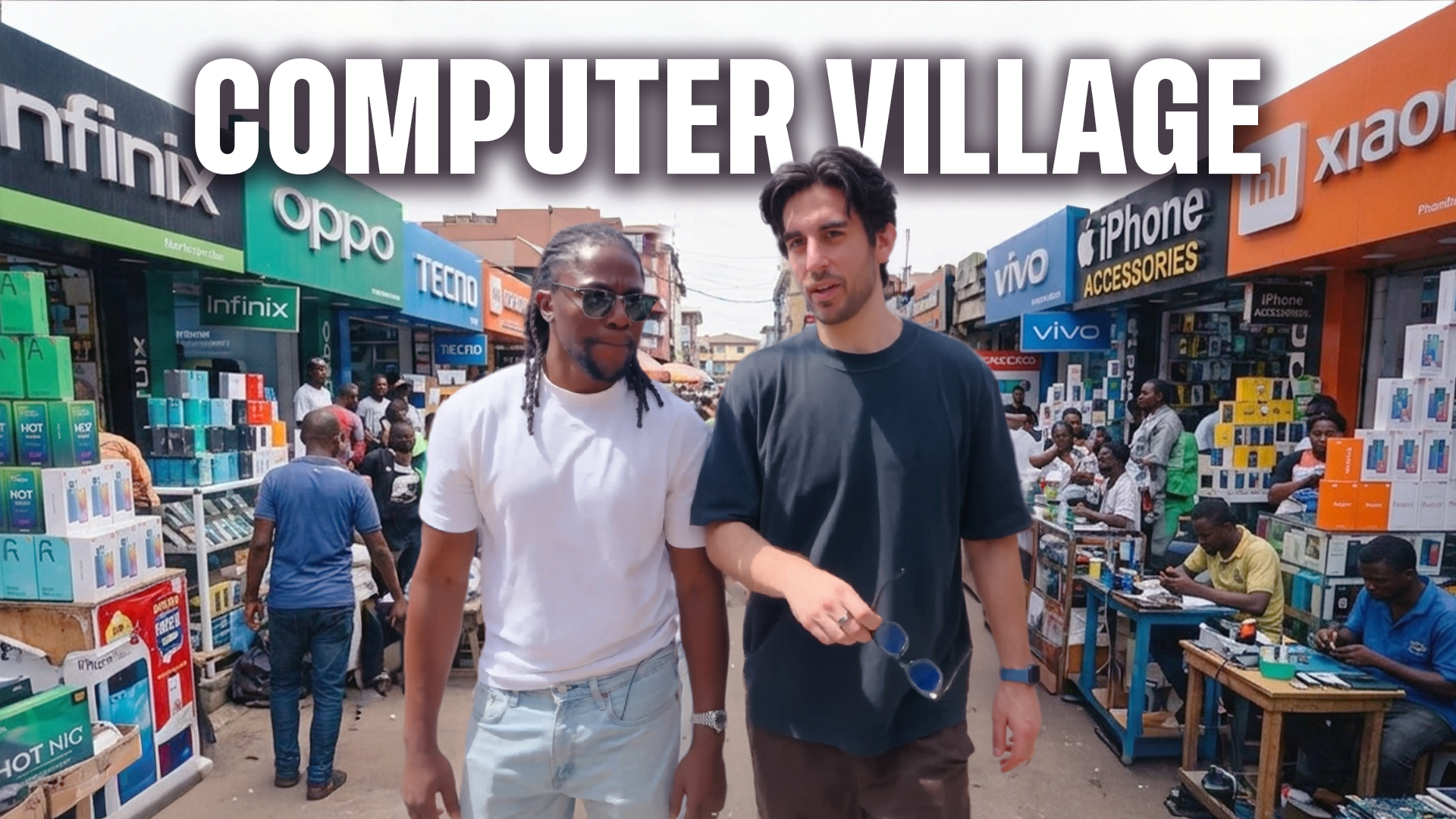


In Lagos' Computer Village, Nigeria's largest electronics market, everything is imported from China. But how merchants access dollars and pay their suppliers is a challenge.
Nigeria imports $20 billion from China every year, yet dollar access problems and legacy banking systems create friction for those doing global trade.
So how do countries like Nigeria and China trade with each other?
In this episode, we head to Lagos, Nigeria, to see it firsthand - how money moves, and how new technologies like stablecoins are facilitating global trade.
In this episode of Money Trails, presented by Stellar Development Foundation.
New episodes straight to your inbox.
Get them as soon as they're published.
Transcript
Justin Norman: I'm in Computer Village in Lagos, Nigeria, where billions of dollars worth of electronics are sold every year. It's one of the largest electronics markets in Africa, and almost everything — new phones, used phones, spare parts — it comes from China. But when I started asking traders how they pay their suppliers...
Justin Norman: Do you use the banks at all?
Labi Idris: [Laughs]
Justin Norman: The formal global financial system doesn't make it easy for a trader in Nigeria to pay their supplier in China. Yet, in so many parts of the world, this is what the economy looks like.
I've always been fascinated by how emerging economies actually work, and how countries like Nigeria and China trade with each other.
So I'm here in Lagos to see it firsthand. How money moves...and how new technologies like stablecoins are facilitating global trade.
Justin Norman: Computer Village is, to me, very representative of Lagos, and perhaps Nigeria as a whole. The hustle, the music, the generators. The organized chaos. A quick phone repair on the side of the road. And everyone here is selling. It's where the traditional and the informal meets the newest technology.
Ife Johnson: We are here in Computer Village where at least 70% of the electronics are sold in, you know, Lagos State.
Justin Norman: I hit the market with my friend Ife Johnson, the Co-founder and CEO of Juicyway, a fintech startup helping Nigerian businesses make cross-border payments.
Ife Johnson: Everybody that sells in this market absolutely imports their stuff. Every single thing is imported — like we have zero production facilities for any type of electronics.
Justin Norman: Infinix, Infinix, Infinix, Infinix, Infinix, Tecno, Tecno. Everything is imported from China. So what it means that this entire market imports things is that everyone has to contend with some sort of FX thing...
Ife Johnson: Correct.
Justin Norman: And so at this grassroots, last-mile level, how does that work?
We met with some cell phone merchants to find out...
John Bassey: I was hustling. I used to sell SIM cards before and I transitioned into selling phones when I started screenshotting products on Jumia. So since then, people started knowing me for devices and I started selling devices myself. So with time, when I got capital and I was getting popular as a Nigerian retailer, but then there was an issue of how do I pay them?
Ife Johnson: Have you ever tried to go to a bank to buy FX? Ever?
John Bassey: No, actually, I've never walked in.
Justin Norman: Nigeria imports an estimated $20 billion from China every year, and the largest product category is electronics.
Ife Johnson: This is a market, like many other emerging markets, that only produces about, you know, 20 to 30% of the things they actually consume. And so you're left with a lot of trade between Nigeria and similar markets like this, with high-production environments such as China.
Justin Norman: China is the biggest trade partner for many countries in the global south like Nigeria, that have low rates of manufacturing. These countries need dollars to import goods, but because of their import deficit, dollar access can be a persistent issue.
Ife Johnson: All global trade has to go through the dollar. The average Joe cannot access the dollar. The dollar is then preserved or kept for those who have the biggest economic advantage in each market. So if you're not, and I want to say this loosely, the top 10% of your industry, like, who's gonna think about you? Like, why should the banks think about you? So you have that 90% of people just looking for informal alternatives. And those informal alternatives, you'll be shocked — like, huge.
Justin Norman: Reports indicate that Nigeria's informal economy is between 55 to 65% of Nigeria's GDP, while accounting for over 90% of the country's employment, and comprising over 40 million small enterprises. But this also impacts how formal businesses operate, which are often using informal or parallel market alternatives as well.
And so a large amount of Nigeria's imports is made up of guys in Computer Village like Ademola.
Ademola Adeleye: So I traveled to China sometime in 2025, and I met with Nigerians every day and they took me to the market where they sell devices — all kinds of devices, from phones, laptops, chargers, camera stuff. And then I met with the suppliers.
Justin Norman: Ademola's suppliers in China will send him videos of their inventory over WeChat.
Justin Norman: So he'll just message you, 'I've got a phone, do you want it?' And you'll say, 'How much?'
Ademola Adeleye: Yes. So when she tells me the price, I'll let her know how much I want. Then she'll send, uh, I wanted four units of this because I still haven't stocked. She'll send me pictures, the battery health, and the front view. And then this is Alipay. And this is me sending money to her.
Justin Norman: Ademola holds a balance of Chinese renminbi in an Alipay account, which he buys from a Nigerian national in China who trades the RMB for Naira.
And he's tracking the exchange rate daily.
Justin Norman: So you're sending them Naira?
Ademola Adeleye: And they send me RMB.
Justin Norman: And they're giving you RMB?
Ademola Adeleye: Yes.
Justin Norman: So maybe like every month or so you'll have to exchange Naira for RMB?
Ademola Adeleye: Yeah. Not every month. Like daily. I do it daily.
Justin Norman: All of this underscores the informality of the system... Consider how Ademola gets his phones from China. He uses what he calls express shipping.
Ademola Adeleye: So we have people that we call flyers. They will take the goods from this warehouse and bring it down to Nigeria on normal flights from China to Nigeria. It takes 18 to 20 hours. So in less than two or three days, we have the items here in Nigeria without stress. It's much more comfortable for me to use the express, because whenever I use the express, I get to receive the goods within two to three days, and I get to sell it fast.
Justin Norman: Ademola is concerned about exchange rate fluctuation, given the volatility of the Nigerian Naira. For these small merchants, there's no currency futures or sophisticated financial instruments. They don't go to the banks.
Justin Norman: Do you use the banks at all?
Labi Idris: As an SME? I don't think banks is your first option. I don't think so.
Justin Norman: Why not?
Labi Idris: Basically, I think the banks favor larger companies — like they've got these big companies and everything's easier for them. But in SME, it's Nigeria, it's always very difficult to get good rates. And let's just move on from there.
Justin Norman: Labi is a cell phone merchant and importer who has to figure out how to pay his suppliers overseas.
Justin Norman: And then you are paying primarily in dollars, right? Yeah. So you have to source dollars?
Labi Idris: I have to source dollars, yes.
Justin Norman: Okay. So how do you do that?
Labi Idris: First, it is actually very challenging.
Justin Norman: And are you primarily sourcing dollars, or are you now primarily sourcing stablecoins?
Labi Idris: Dollars, basically.
Justin Norman: Okay. Dollars basically, primarily — but not USDT?
Labi Idris: More of USDT, actually.
Justin Norman: Or are you just looking at it in the same way? It's the same thing.
Labi Idris: Actually, I feel like — I don't know much about it — but I actually feel like it's the same thing. Just give me a good rate however you want to get it.
Justin Norman: These traders are sensitive about rates because of the Naira's recent history of volatility and restrictive monetary policy. Nigeria's main export is oil, which accounts for 90% of Nigeria's FX earnings. But when the price of oil has decreased, it has threatened Nigeria's fiscal and monetary stability.
When oil prices collapsed in 2014 and again in 2020, Nigeria faced serious dollar shortages. The Central Bank's response was to control who could access dollars and at what price, maintaining an official exchange rate.
Ife Johnson: It was never about the buyer versus the seller. It was always about, you know, what the government indicated the rate — it banned a fixed band by the government, you know, fixed liquidity injections on a periodic basis, because they were the principal suppliers of the dollars.
Justin Norman: In 2015, the Central Bank banned 43 categories of goods from accessing official FX rates — including essentials like rice, cement, and palm oil — in an effort to conserve reserves and encourage local production. The actual impact was to push importers of these goods entirely into the parallel market.
2019 to 2023 represented the apex of foreign exchange illiquidity in Nigeria, and a growing gap between the official government rate for dollars and the actual rate on the parallel market, which reached as high as 62% in 2023.
No one was immune from these issues — even Africa's richest man, Aliko Dangote. International airlines had $850 million in ticket revenue "trapped" in Nigerian banks, unable to be converted into dollars. So Dangote Cement and Ethiopian Airlines had to bypass the banks entirely, performing a barter-style swap of $100 million just to keep their operations alive.
Ife Johnson: And they figured out, you know what? We don't have a rate — we're just gonna do a swap. You convert your Naira equivalent to a dollar equivalent. I convert mine to a dollar equivalent. We do a swap, we net it off. And the money never really moves.
Justin Norman: When President Tinubu took office in 2023, one of his first moves was to let the Naira float freely, allowing the market to determine its value for the first time in years.
Ife Johnson: Now they've realized, you know what, maybe we don't control the supply of dollars into the economy. Maybe what we want to have instead is somewhat of a “free-floating” economy where the dollar seller and the dollar buyer can meet easily.
Justin Norman: When the currency was floated, the market correction led the Naira to immediately lose a third of its official value and record inflation for Nigerian households.
But the government felt it was short-term pain for long-term gain. Since then, the parallel market premium has shrunk to nearly zero, and net foreign reserves climbed to $35 billion from a low of just $3 billion a few years ago.
Justin Norman: In Nigeria, there are no Apple Stores, so if you're buying a cell phone, Computer Village is where you shop. And markets like these are crucial distribution points into the economy. This fragmentation and informality, and the recent history of Nigeria's monetary policy, impacts how everyone trades, including formal businesses.
Justin Norman: Why do the importers — these big multinationals — need to go to the parallel market in the first place?
Emeka Ajanah: Anyone who needs currency traditionally would not think of the bank first. They would always think of the parallel markets.
Justin Norman: Emeka Ajanah operates a foreign exchange platform. He's an OTC trader who fills the gap for those sourcing FX to do cross-border trade.
Emeka Ajanah: I looked into the space where I belong, which is a financial institution, and I'm saying, 'Hey, how can I create a relevance for myself where, in the far future, 10 years from now, I'm still very relevant within the ecosystem?' Let's look for a national issue that we have in Nigeria. And I'm like, okay. I think that's the FX problem.
Justin Norman: During the recent period of dollar scarcity, even formal institutions would come to people like Emeka, because the parallel market could service their demand better than the banks. And even as the dollar scarcity issues are rectified, these non-bank options are still often preferred.
Emeka Ajanah: Their FX demands are really much — they're huge and too much for the banks to handle. So if the banks can't handle it, the best option is to go to the parallel market, right?
Justin Norman: Why can't the banks handle it?
Emeka Ajanah: That's a national problem. That has always been a national problem.
Emeka Ajanah: You tell your bank, 'I have Naira in my account and I need some dollars, so you can debit my Naira at the central bank rate and, you know, remit it on my LC.' That typically could take — due to documentation and processes back and forth — could take like three to four days. But for Park Pay, you could approach us, and we can deliver that in one day.
Justin Norman: And so is the parallel market faster because you don't have to go through all of the bureaucratic process?
Emeka Ajanah: Yes.
Justin Norman: Or is it also faster because you are doing a better job of sourcing liquidity than the banks?
Emeka Ajanah: So it is both, yeah.
Justin Norman: Ultimately, the challenge that has to be dealt with is orchestration...
Ife Johnson: Which is: when the dollar supply is available, how quickly can it be, in quotes, orchestrated or matched to the demand?
Justin Norman: So the liquidity is fragmented.
Ife Johnson: Yes. Yeah, it's in pockets.
Justin Norman: Which is a result of the informality of the market.
Ife Johnson: Correct.
Ife Johnson: There's pockets of liquidity, there's a matching problem, and then there's scarcity. It's both, and the fragmentation compounds the scarcity issue. And given how constrained the access has historically been, and the inefficiency of correspondent banking, it further compounds that problem.
Ife Johnson: It's like, what part of the market is actually at some type of inertia? And that big question, that's what entrepreneurs like myself have to be able to answer.
Ife Johnson: We help businesses and individuals who do business with Africa and in Africa spend local currency with the ease of global currencies. And for that to be true, we match the supply of global currency near real time with the demand for that global currency, 24/7.
Justin Norman: How do you do that?
Ife Johnson: Stablecoins.
Justin Norman: The bet today is that stablecoins solve the orchestration problem: Stablecoins have instant settlement, 24/7 operation, and visibility across the entire global market.
Ife Johnson: Now you have this new technology in stablecoins where it's like the execution and settlement of the dollar happens in one atomic event. That's not true for correspondent banking. That's a big flip.
Ife Johnson: As a result, you have a quicker-moving economy. You have, you know, a money supply dynamic in the economy that just optimizes for efficiency.
Ife Johnson: Like, what this is supposed to fix is trade. The whole opportunity is anchored in fixing global trade. How?
Justin Norman: And that's a gigantic opportunity.
Ife Johnson: Huge. Huge. How Nigeria trades with the world, how Africa trades with the world, how every market that has correspondent banks trades with the world.
Justin Norman: And with each other.
Ife Johnson: Yes. And with each other, by extension. Like, if that inefficiency did not exist, what would that intra-Africa opportunity be? I dare say that is also a market in inertia. It's like it's just waiting for the right innovation to, you know, make it work.
Justin Norman: But the key thing is, no one really cares about stablecoins. It's just about better tools for global trade.
Ife Johnson: If I'm a merchant in Computer Village, what do I want to do? I want to get dollars over to my supplier as quickly and as efficiently as possible. Full stop. I don't care how it's delivered.
I just want my money delivered quickly, efficiently, compliantly, and of course at the best possible pricing. So a merchant doesn't come to me because they want stablecoins. A merchant comes to me because they want to make a payment. And if stablecoins makes that payment more efficient for them, I'm happy to use it.
Justin Norman: I think my experience in Nigeria can be extrapolated. China is the factory for many countries around Africa, LatAm, and beyond. These countries have to contend with dollar access and liquidity issues. They have devaluing currencies. There's fragmentation and larger informal economies .And not surprisingly, these are the countries also leading in stablecoin adoption.
So I'm watching where this goes. Nigeria, and countries like it, are full of friction. And I'm excited by the potential for greater economic velocity in the places that need it most.
Justin Norman: In the next episode of Money Trails, we head to Syria, where a decade of civil war has led to some pretty unique financial innovation...
Younes Al Haj Saleh: They take the money in cash and they drive back to Syria. And people used to come and get their salary in hats.