Why Getting Paid Costs More in Emerging Markets
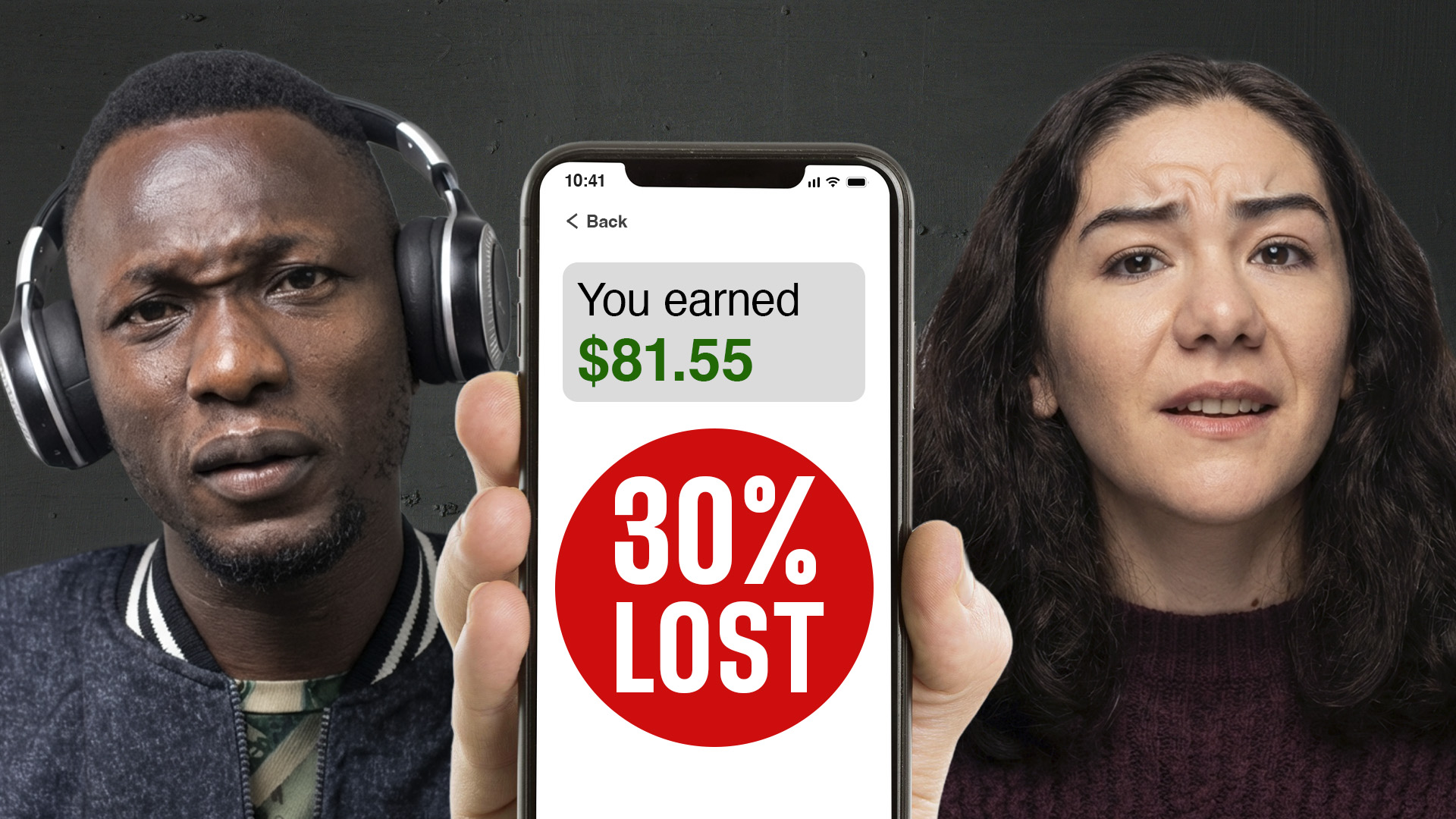


If you're a freelancer or a remote worker from the global south, you likely have a harder time getting paid and participating in the global economy.
Maybe a global payments company doesn't operate in your country. Maybe they banned your account or froze your funds.
Remote workers and freelancers from emerging markets often have to jump through hoops to get paid, incurring additional costs along the way.
Meanwhile, more people than ever are working online, and more of these workers are coming from the developing world. Yet the global payments system is often failing the very people who rely on it the most.
Are stablecoins the solution?
This episode of Money Trails is presented by Stellar Development Foundation.
New episodes straight to your inbox.
Get them as soon as they're published.
Transcript
Justin Norman: Look at this email. This is the email that made me realize the global payment system is broken.
"We're sorry to inform you that we've made the decision to cancel your transaction and close your account... we're not legally able to tell you the exact reason for each closure. Please visit our help pages for more information."
I had the invoice. I had proof of work delivered. I had all my documents. It didn't matter. If this happened to me—an American trying to pay someone in Ghana for legitimate work—what's happening to the billions of people in countries these platforms have already decided are “too risky”?
Sunday: They suspend people's accounts, seize their money and not give a concrete explanation.
Lyra: Sometimes the money is just frozen and sadly I have to wait.
Ramy: I've been having a lot of issues when it comes to payment.
Sandra: If you could imagine these opportunities that I'm missing because of a platform, then you should know how much I'm frustrated.
Justin Norman: Today, more people than ever make a living earning outside of their home country, yet the global payments system is often failing the very people that rely on it the most.
When my first account was banned, I took to Twitter—where I learned firsthand how prevalent this issue is.
Accounts blocked just for sending money to certain countries. Entire countries cut off overnight. Funds frozen with zero warning.
Everyday people trying to get paid online, and having an excessively hard time doing so.
I wanted to better understand their experiences, so I reached out to some freelancers...
First, these freelancers essentially have to pay an extra tax.
Sandra: The bank intermediaries are going to charge, then Payoneer—the platform I am working on... And then the bank that I would be transferring my money from plus the conversion rate and all of that.
Justin Norman: For a freelancer like Sandra who works on a platform, earns in dollars, and then has to convert that to her local currency, this is what it looks like.
Let's say she earns $100.
First there's the platform service fee. Then, a platform withdrawal fee to a payment service like Payoneer. Then, a Payoneer withdrawal fee. And currency conversion. And on top of that, a local bank processing fee.
But these payment platforms also don't often support certain countries, leaving freelancers to jump through hoops to get paid.
Sunday: When I receive money from clients into my PayPal, I have to send the money from my PayPal account to my friend in the UK. So my friend in the UK helped me convert the money, sends me naira from his own Wise account. Which is my workaround from PayPal account because PayPal don't let Nigerian account receive.
Lyra: I received an email that you are from this is no longer supported. We blocked your account. And it's always like that panicky feeling because if my account is blocked, the money can also be gone.
Justin Norman: And in the end, there are real, human costs to this exclusion.
Melsida: Two companies wanted to hire me and I got accepted, but they just said they can pay me only by Payoneer and they have no other payment system. So I couldn't proceed with the jobs because of the payment system failure...
Sandra: I lost a gig because my client was really emphatic on paying through my PayPal account. But since I haven't had my PayPal fully set up or linked to a US bank account, I couldn't secure that gig.
Lyra: We are here because we lack these opportunities at home because in my country there is a very high rate of unemployment.
This talk is so important to me. So raising my voice about these payment challenges because I strongly believe that people from any other developing country deserve to be part of the global market...
Justin Norman: But why does this happen? Why is participation so challenging for certain groups of people?
Every financial company is beholden to Know Your Customer and Anti-Money Laundering laws, and American financial institutions spend an estimated $50 billion per year in AML compliance costs.
So these companies employ "de-risking" practices, where they choose not to service customers from certain segments or certain regions.
Research finds that those most vulnerable in the de-risking cycle are the low-margin customers.
Ruben Galindo Steckel: In the world of payments, people are making basis points.
It's just very difficult and it's costly. You have to set up that infrastructure, the banking relationship, the connection, the FX management.
And so it's mainly because it's not worth it for all these companies to service these countries well...
Justin Norman: But this isn't a niche issue. These are important growth markets.
When you look at the macro data, you realize this is a massive demographic shift that the global payments infrastructure isn't prepared for.
According to the World Bank, over the next 10 years, 1.2 billion young people in emerging economies will become working-age adults, while the job market in these economies is only expected to create 420 million additional jobs—risking leaving nearly 800 million young people in economic uncertainty.
Not enough local jobs are being created and the only option for millions of people is to earn online, and as part of the global economy.
By 2050, 59% of the global working-age population will reside in lower-income economies—the very countries that struggle the most to participate in the global economy.
The online work economy has been growing at double-digit rates every year, faster than traditional workforce, and it will continue to do so.
And we need better infrastructure to support where the growth is coming from.
If legacy financial infrastructure doesn't work for emerging markets, there are many who believe that crypto—and stablecoins in particular—are the solutions.
After all, anyone can have a crypto wallet, so anyone can be paid in stablecoins.
They're borderless, decentralized, and permissionless, and they enable near instant cross-border payments that don't need to go through legacy payment rails.
Ruben Galindo Steckel: And I think that that's a big challenge with stablecoins as well, because we are seeing that marketplaces are adopting stablecoins as a mechanism to deliver payments. However, delivering a stablecoin payment is half of the solution, right? Because then that stablecoin, like the PayPal balance, needs to get converted into local currency.
It's a very, very tough issue.
Justin Norman: Ruben is the Co-founder & CEO of Airtm, building cross-border payments infrastructure on the Stellar blockchain.
Ruben and Airtm are ultimately trying to solve this last-mile problem that the global workforce has to contend with.
I have some form of currency, I need to access it to pay for stuff where I live.
Ruben Galindo Steckel: When you're trying to go from a US dollar to local currency, it's tough because all the infrastructure is not there in every country.
There's all these people that are getting paid with, you know, an Amazon gift card or a Payoneer transfer, or a Neteller or Skrill or whatever payment method that's global because it lives on the internet. And they're stuck with that balance, trying to figure out how to use it to pay for rent.
We had to build a marketplace like eBay, but instead of bicycles or a stove being sold on eBay, at Airtm, people buy and sell dollars to and from each other... Cashiers are basically dollar brokers.
Justin Norman: Airtm built a global peer-to-peer payments marketplace across 600 different payment methods.
Ruben Galindo Steckel: That whole process might seem cumbersome, but you get matched with the cashier in less than 13 seconds. 50% of transactions happen within 13 minutes. A hundred percent of transactions happen within an hour.
Justin Norman: Airtm's data shows that users are even willing to pay a premium to access their funds immediately, and in the currency of their choosing.
Ruben Galindo Steckel: We realized that people who got paid in PayPal were willing to lose 30% of the money they earned on PayPal to cash out that PayPal balance.
It was across the board. There was a willingness to pay the premium in almost every country in Latin America and even countries outside of Latin America.
In a way, if you can't seamlessly access the US economy or the European economy, you can collect a payment. You have to work even harder to make the same amount of money because it's gonna cost you sometimes even 30% of the money you earn online.
It's like there's a tax in the global south where if you want to get connected to the global economy, you need to pay a tax because the infrastructure that would make it seamless, make it free, make it fast—it's just not there.
There's a fallacy all these marketplaces have. They all believe that this problem is solved.
They don't realize the hoops that the people have to go through to actually be able to use that money.
And so, no, the problem with payments is not solved. It's a hundred percent not solved.
Michelle: For me it's freedom when you are not locked in any kind of way. When I get paid I don't want to think about how I have to do all the circuit not to lose money. I want to get paid and I want to use the tool that I've been paid for for anything else, you know.
Justin Norman: That's how it should be.
Michelle: Definitely.
Justin Norman: Now, to their credit, many of these same global payments companies are adopting stablecoin and blockchain technology, and the hope is that it leads to more inclusive access to the global economy.
But the question isn't whether we need better infrastructure. The question is whether we'll build it fast enough to serve the people who need it most.
Because right now, millions of people are still paying a tax that I don't have to pay—not because they're doing anything wrong, but because of where they were born.
And it's these same people, from these places, that are the future of our global workforce.
In the next episode of Money Trails, we head to Lagos, Nigeria, and explore how money moves across borders at one of Africa's largest electronic markets.
Ife Johnson: We are here in Computer Village. Everybody that sells in this market absolutely imports their stuff.